
Everyone can (generate) design, now what for designers?
When the execution part is getting easier, does it mean anyone can be a designer? Design is not only about execution. Critical judgement and ability to understand users remain important traits.

When I was a young designer doing my bachelor degree in drama with specialise in scene and lighting design, we usually got a lot of feedbacks on how our design convey messages and telling story for the scene or the play. My style was always about hidden messages and symbols on the stage that delivering to audience without speaking out loud. At the same time the design has to be functional, work with characters on the stage and help audience understand those characters.
Similar part with designing interface for users. We cannot speak out loud to explain how the screen’s functionality works, so we have to make the design speaks for itself and being clear as much as possible. We also have to make the interface work according to users’ mental model so doing user research is critical.
When AI allows everyone to execute design, at the surface it seems like the main part of our creative job is being taken away from our hands. But execution is only one of many parts of being a designer.
Here’s the example…
This year I own a year-long project at work and I’ve only been spending 2-3 months on Figma to actually executing the design. The other months are about research, auditing, analysing, synthesising, workshop, stakeholder management, strategic planning, communication, discussions and feedback loop.
The milestones on my project roadmap look like this:
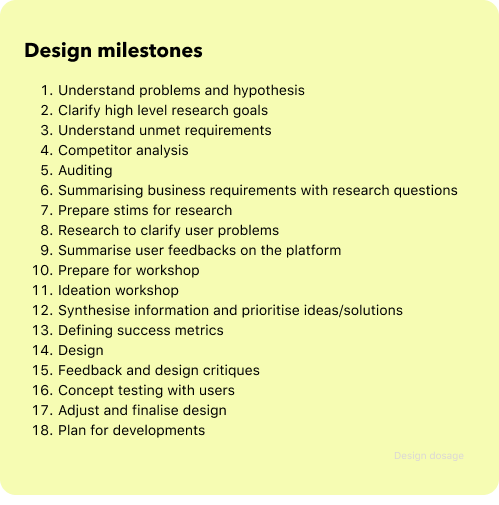
The areas that I use Figma to executing design are only number 7, 14 and 17. So I hope this is a proof that designers have to do much more than just executing design. We are also hired to communicate, think and criticise design together with understanding users (if you are at the right company that understands design). It should be obvious that by having GenAI generating design will not covering the whole process of designing something.
What’s concerning for me here is not about AI replacing designers. But it’s about how much companies understand factors behind good design.
If you look at my one year roadmap, you will think I’m quite fortunate that my company has somewhat understanding of design process and why it takes time. But do all companies understand this?
Will they allow designers to spend enough time researching before executing the design?
Or most importantly, do designers know how to manage and utilise their skills beyond just execution?
AI is making it look so simple to execute something visually and I’m afraid it will make companies feel that designers are simply replaceable because they are so focused on short-term gain and execution mindset. In most companies, design are still reactive, fragmented, or isolated. Design teams are not fully integrated with business goals, outcome and we are not yet being placed as strategists.
With low design maturity, company can being lured into short-term focus that can maybe achieve with fast paced execution and will never try to understand what’s the users really need.
I’m not trying to say that AI is not useful. It is extremely useful for ideation phase, design agency or hackathon where we can have rapid ideas generated. But when it comes to complex product implementation, there are a lot of factors we have to take into account when designing, especially if you have specific user groups (like B2B products, for example). Some of the cases we have with B2B products are very specific and I find it can take more time for me to try making AI understand the complexity.
At the end, AI helps us analyse data, ideate and execute design faster than before. We can use it as a tool to help us design but it is very difficult for me to see it is being used as an excuse to exploit designers or even for questionable layoffs in companies around the world.
How do we avoid it? — I don’t know.
I think the technology has to advance and we are in such an uncertain era. Right now the only advice I can give is to stay relevant. Ensure our soft skills are intact. Learn to become really good at collaborating with both AI and people. Your skills in critical judgement, strategic thinking, problem framing, conceptual thinking, system thinking, story-telling, communication and empathy are crucial for today and the future. We will definitely need them more and more, not just as designers but as human-beings.